Fusion is the source of energy in the universe
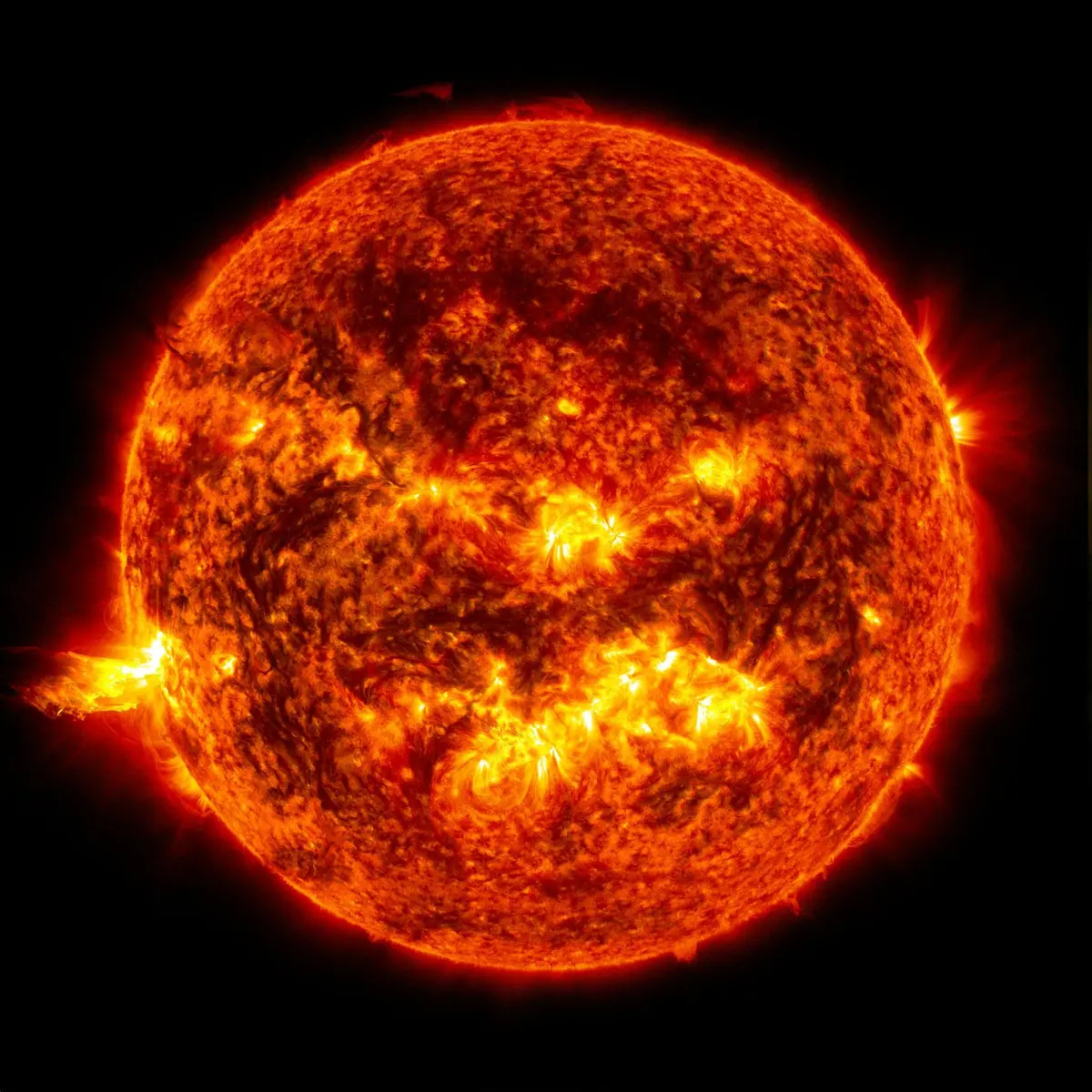
Fusion in the stars
Fusion occurs when light atomic nuclei merge and release energy in the form of light and heat. The atomic nuclei exist in a plasma state, allowing ions and electrons to move freely among one another.
In the universe, it is the gravitational force of stars that creates the conditions necessary for fusion. In this way, stars form larger and heavier elements.
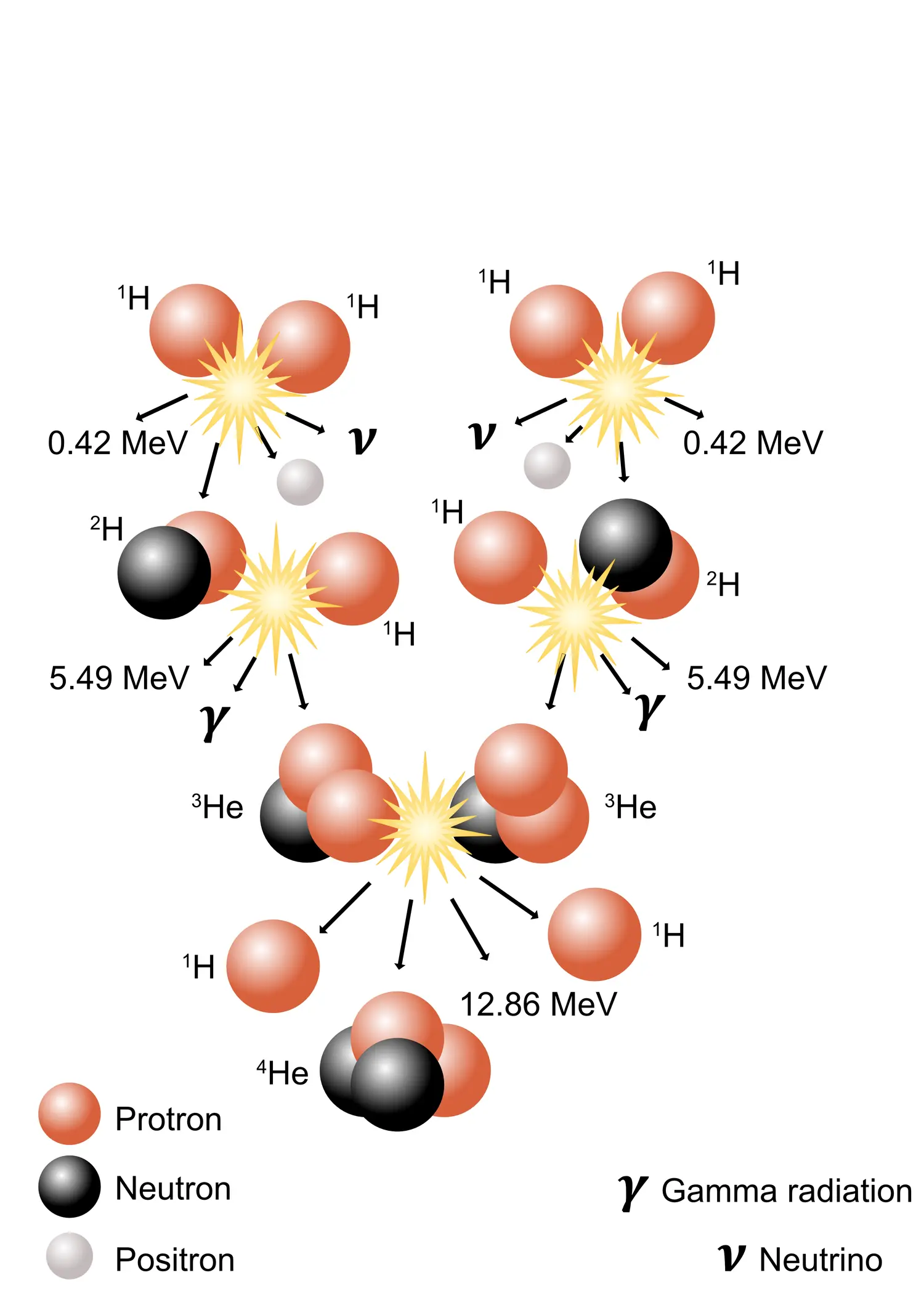
The dominant fusion process in stars, including the Sun, is the proton–proton chain. It is a series of reactions that convert hydrogen into helium.
Plasma makes up about 99.9% of the observable universe
On Earth, we mostly know plasma as the fourth state of matter, alongside gas, liquid, and solid. In everyday life, plasma can appear in the form of northern lights or lightning strikes.
The fourth state of matter
While a gas consists of atoms or molecules and is electrically neutral, plasma is heated gas in which the atoms have been split into positively charged ions and negatively charged electrons. So, plasma is electrically charged particles. Therefore, plasma can conduct electric current, and it can be shaped or controlled using magnetic fields.
Extreme conditions
For fusion to occur, positive ions - which would normally repel each other - must be forced close enough together for them to merge. To achieve this, they must overcome the so called Coulomb barrier. In a star, this happens because the star’s gravity compresses the plasma so intensely that extreme temperatures and densities arise.
Levitating plasma
The plasma in a fusion reactor must not encounter anything, as its temperature far exceeds the boiling point of any material. To isolate the plasma, it is kept suspended by powerful magnetic fields inside a vacuum chamber.
To achieve sufficiently high temperatures for fusion processes to occur, the plasma must be confined. This can generally be done in two different ways: magnetically or inertially.
mrFusion’s solution is a magnetic mirror configuration.
In general, a magnetic mirror configuration is a simple and linear setup, consisting essentially of a vacuum system with strong magnetic fields at the ends.
mrFusion develops technologies that improve the magnetic mirror-configuration.
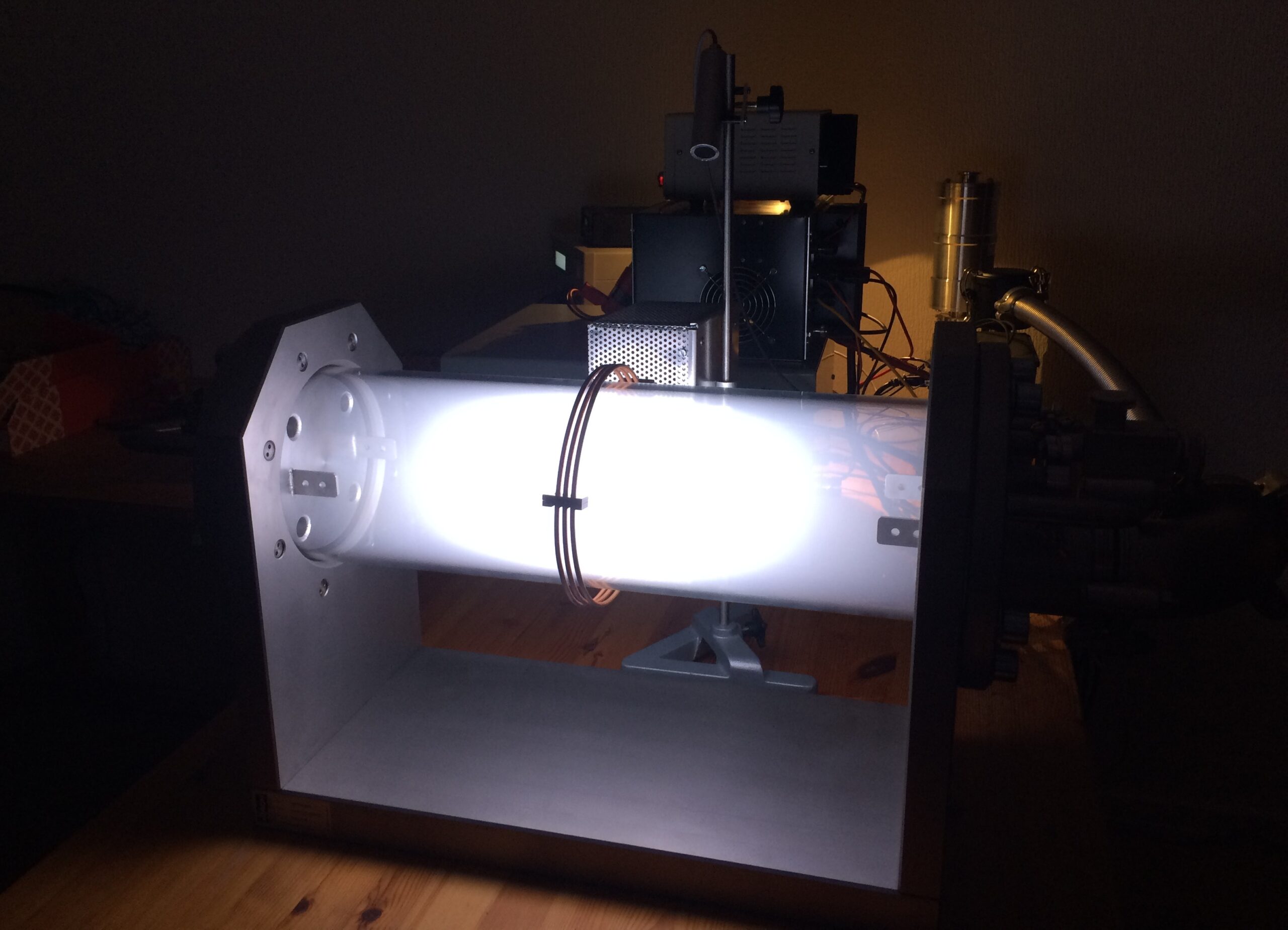
Early test of radiofrequency plasma heating. The plasma is relatively cold and without confinement.
Cost-effective with efficient use of the magnetic field
A magnetic mirror is characterised by a high beta value, β. The beta value expresses the ratio between the plasma pressure and the magnetic pressure. The higher the plasma pressure, the more fusion processes and the better the utilisation of the magnetic field. Magnets are an important and costly component in a fusion reactor, so efficient use of the magnetic field is essential.
RAMI
RAMI (Reliability, Availability, Maintainability, Inspectability) is fundamental for moving from fusion research to commercial power plants. A magnetic mirror configuration has a clear advantage over torus- or laser-based configurations due to its simple geometry.
Scalable
Developing and industrializing fusion energy based on a magnetic mirror configuration will be less costly than other solutions, because the geometry of a mirror configuration is linear and simple. This makes the solution easy to scale.
Compact
Strong magnetic fields are required in a fusion reactor, but the magnet system in a mirror configuration is often more compact and simpler to manufacture and integrate into a supply chain than the complex magnet systems used in torus-shaped reactors.
Open-ended
A magnetic mirror always has an open magnetic field line structure and is referred to as open ended. An open-ended configuration enables direct conversion to electricity. It also facilitates the removal of impurities and helium, which is the byproduct of the fusion process.
Boron - the energy source of the future
Aneutronic fusion
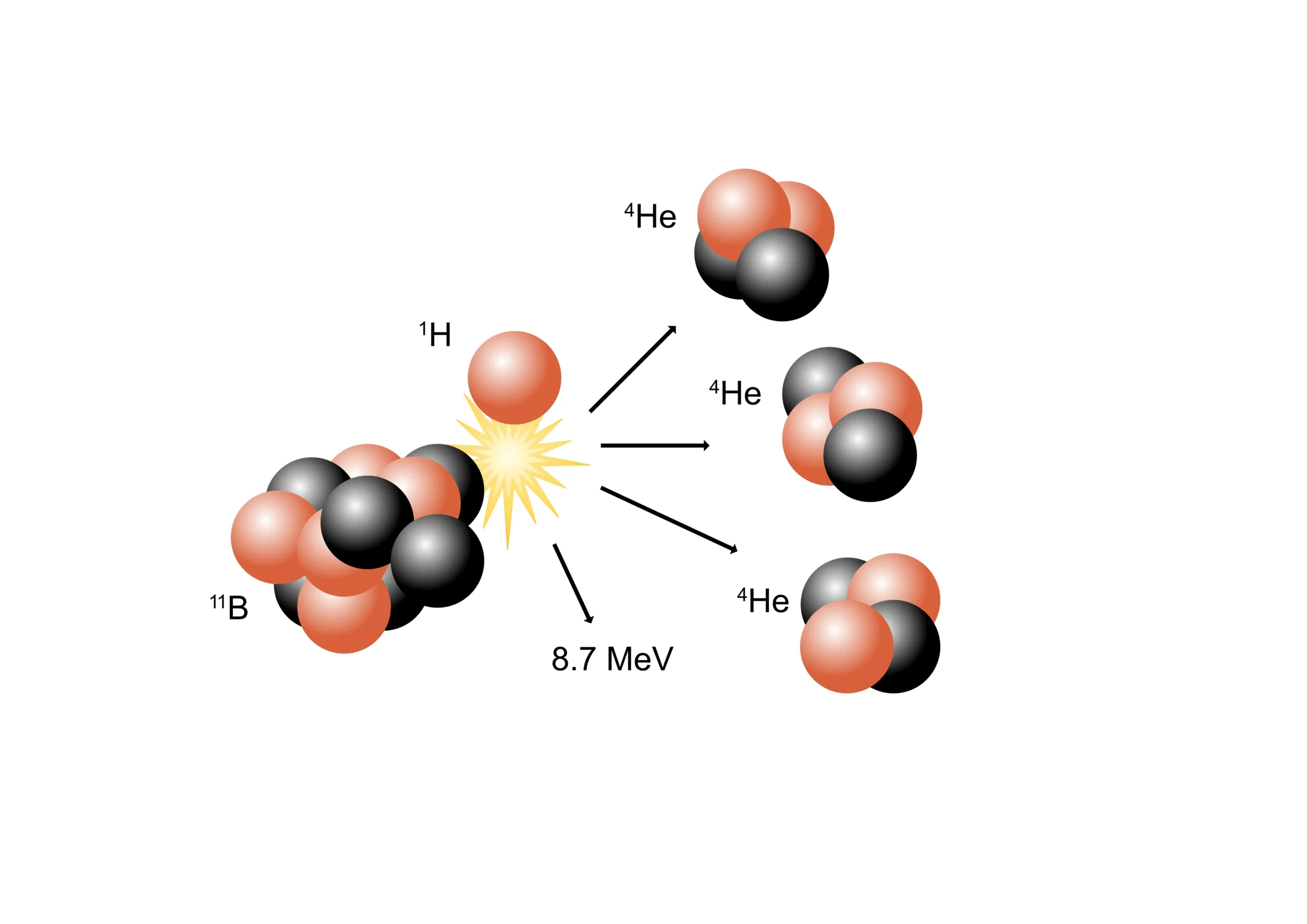
The proton–boron reaction is aneutronic. Aneutronic means without neutrons. The reaction product is helium. No high energy neutron radiation is produced. This avoids neutron bombardment of reactor components, preventing structural degradation and eliminating neutron induced radioactivity.
Proliferation resistant
It is not possible to develop nuclear weapons from boron or from the byproducts of proton-boron fusion. As a result, it requires fewer safeguards and less regulatory oversight compared with other forms of nuclear energy.
Direct energy conversion
A magnetic mirror configuration using proton-boron fuel is well suited for direct conversion to electricity. The simple magnetic coils, the absence of a steam cycle, and the lack of heavy radiation shielding reduce the capital costs of the energy system.
Fusion propulsion for space missions
Proton-boron fusion is an ideal choice for space based energy systems, including propulsion. Direct acceleration of charged particles provides extremely high efficiency and enables shorter travel times in space. Because the process is aneutronic, it offers a major reduction in the weight required for radiation shielding.
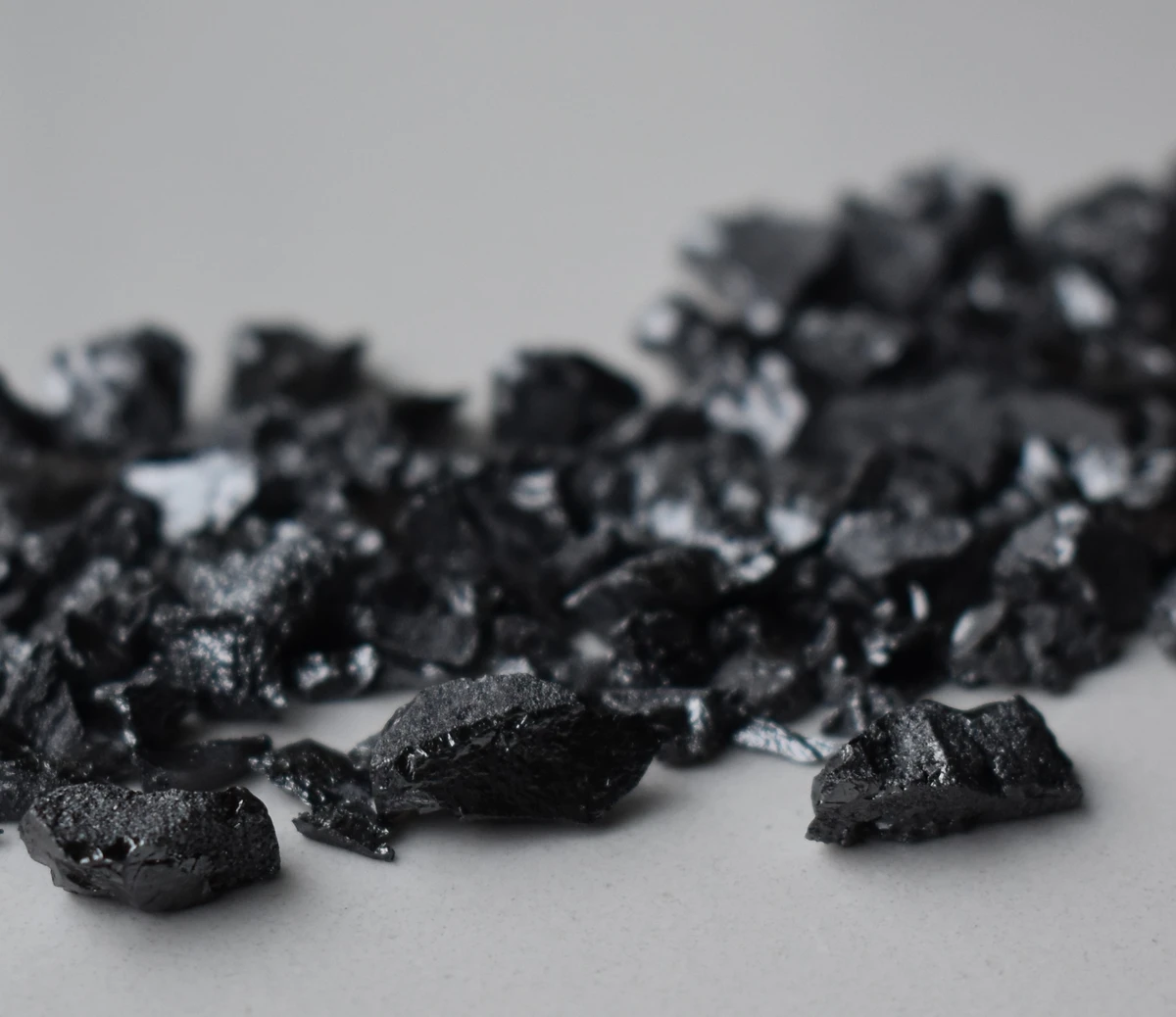
Boron is the 5th element in the periodic table. The image shows crystalline boron. Boron is commonly found in the Earth’s crust and is used industrially. Fusion uses the isotope ¹¹B, which has 5 protons and 6 neutrons in its nucleus. ¹¹B accounts for about 80% of naturally occurring boron reserves. The illustration shows a fusion reaction between hydrogen and boron, releasing three helium nuclei and 8.7 MeV of energy.
Realising fusion energy
mrFusion develops unique solutions for plasma confinement and for reducing radiation losses and turbulence to deliver aneutronic fusion energy.